The Approach
Most companies don’t have a marketing problem. They have a clarity problem.
Here’s how I think about the Clarity Gap, and how I close it.
Part one: The Clarity Gap
You can’t read the label from inside the jar.
If the gap is so visible to the market, why can’t leadership see it? Because you’re inside the jar. You’ve spent years fluent in your own language (your roadmap, your acronyms, your internal debates), and somewhere along the way you started talking to yourself instead of your customer.
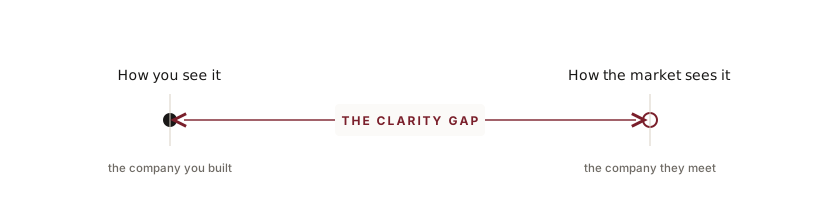
The Clarity Gap is the distance between how you understand your company and how your market experiences it. It opens from two directions:
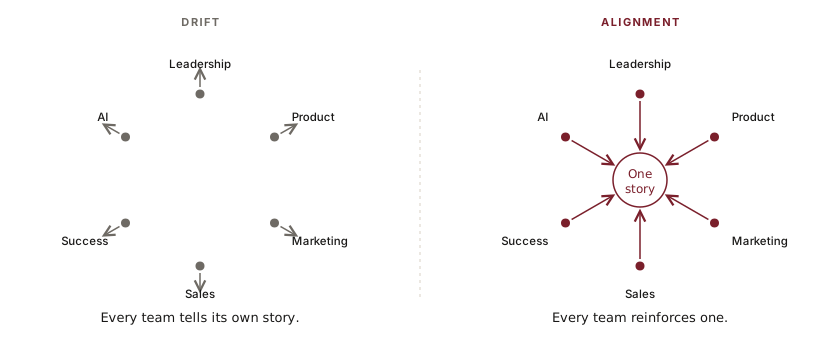
- Inside, your teams stop telling one story. Sales, marketing, product, and leadership each grow expert in their own version, and every version is right and none is complete.
- Outside, you stop translating that story to your customer. You get so close to the business that you assume the market sees it the way you do. It doesn’t, it can’t.
The thirty-second test. Here’s the question I put to leaders: if you knew nothing about your own business, what would you think after thirty seconds on your homepage? Most can’t answer it, because they stopped seeing themselves the way their customer does. That blind spot is the gap.
Checkers vs. chess. An expert plays their own square, four squares at most, and plays them well. The CEO has to see the whole board, because each move affects every other move. The higher you sit, the more of the board you see and the less of the detail. That’s not a flaw. That’s math. It’s also exactly how blind spots form.
A Clarity Gap isn’t a failure of effort or intelligence. It’s the natural cost of growth. Healthy companies don’t avoid it, they just refuse to ignore it.
Part two: Go-to-Market Alignment · inside
Get the company telling one story.
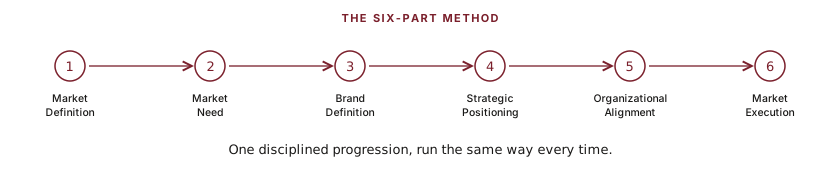
The internal work. Once you can see the gap, closing it inside takes discipline, not inspiration. The Alignment work runs the same six-part progression every time.
- Market Definition. What market are we actually in? The market you’re best positioned to serve, not the one you inherited or the one competitors claim.
- Market Need. What do customers really hire us to solve? The problem in their words, and the forces driving them to act.
- Brand Definition. What should we stand for? What the company represents in the buyer’s mind, and the role it plays.
- Strategic Positioning. Why us? Why we win, and why anyone should believe it.
- Organizational Alignment. Does every team reinforce the same answer? Leadership, product, marketing, sales, customer success, and AI, all working from one playbook.
- Market Execution. Does it show up everywhere customers meet us? Website, sales narrative, content, thought leadership, AI, every touchpoint.
Part three: Go-to-Market Translation · outside
Make the market actually understand you.
The external work, and the side of this I’m known for. You know exactly who you are. Your customer doesn’t. Translation deconstructs your go-to-market and rebuilds it into something the customer understands, values, and wants a relationship with.
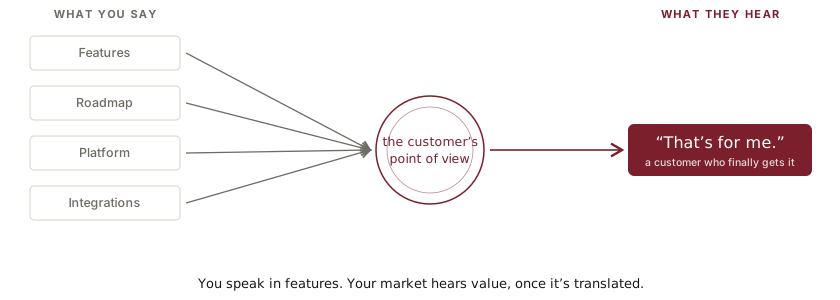
- Strip the internal language. Divorce the story from your roadmap, your acronyms, and your org chart. If a customer wouldn’t say it, it goes.
- See through the customer’s eyes. What does the right buyer actually need to hear in the first thirty seconds, and what do they need to feel?
- Find the one thing. The single reason the customer you’re built for should care, said in their words, not yours.
- Reality-test the difference. Are your unique selling points ones only you can claim, or just variations on what every competitor already says?
- Rebuild the go-to-market. Message, positioning, and the customer relationship, a reason to trust you, not just a list of what you sell.
- Put it where they are. So the translated company shows up everywhere the market looks, and the story finally lands.
Do this, and you stop being the best-kept secret in your category. The market meets the company you built, and sees why it matters to them.